Ak · Community module
Akva
Water Chemistry — the Akva module — takes a table of water analyses and tells you whether each one is self-consistent, what kind of water it is, and whether it is fit for irrigation.
Included free in every edition of GibbsStudio.
What Akva does
- Columns matched by name
- Import analyses from CSV, tab-separated files or SQLite. Columns are found by name, not by position, so the order does not matter and extra columns are ignored. A blank or non-numeric cell is reported as missing rather than guessed at.
- The ion balance first
- The charge balance error is computed from the eight major ions in meq/l, against the tolerance you set. A sample outside it stays in the table but can be left out of the aggregates and the diagrams.
- Water type, facies and irrigation indices
- Each analysis is named by its dominant cation and anion and by its Piper facies, and scored with SAR, Na %, RSC, the Kelly ratio, magnesium hazard, permeability index, hardness and — with conductivity — the USSL class.
- Aggregate by point or category
- Earliest, latest, minimum, maximum, mean or median, so you can ask what a spring is like rather than what one bottle was like. Each aggregate says how many samples it came from.
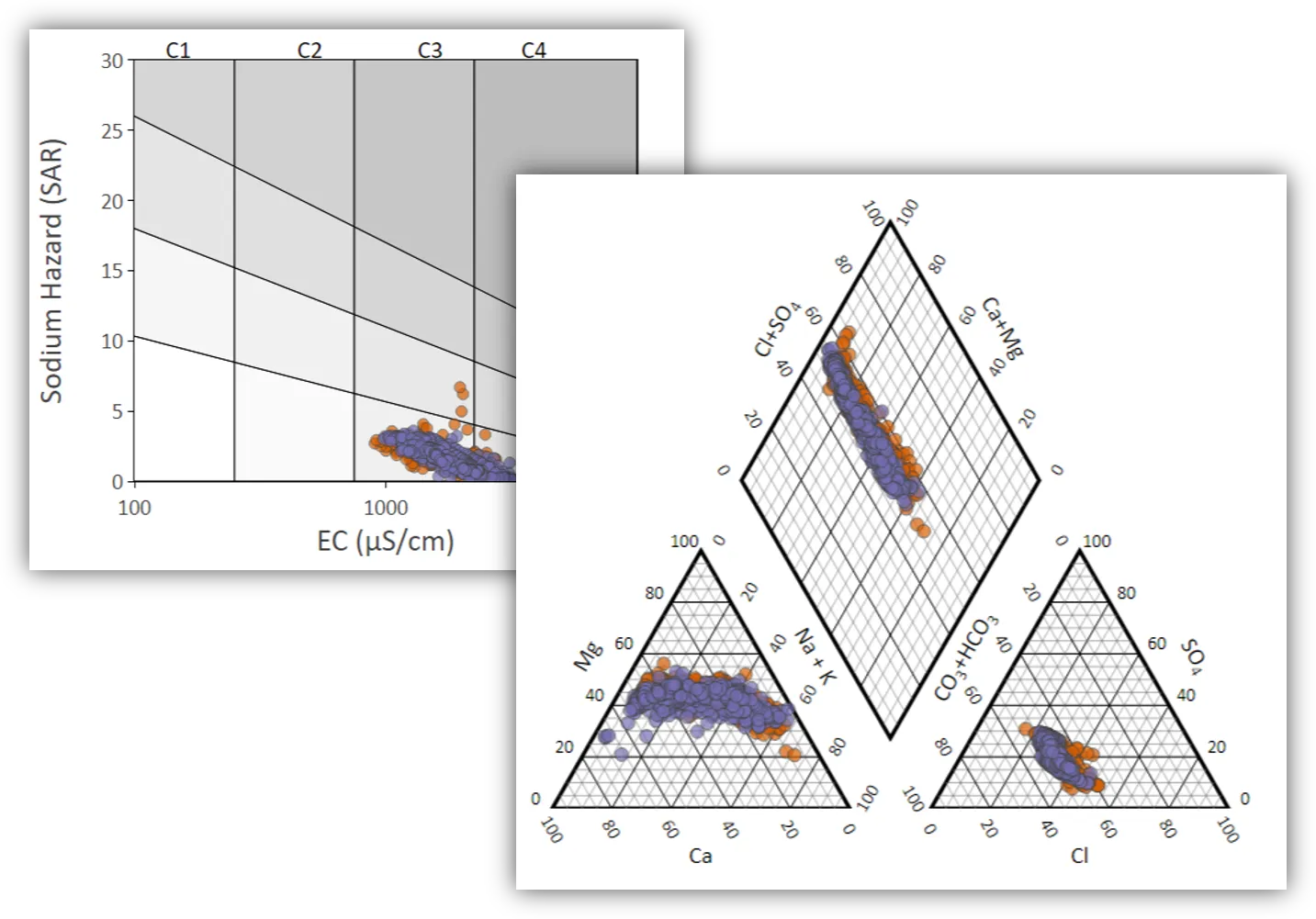
- Piper, Schoeller and USSL diagrams
- The three diagrams hydrochemists expect, each available as a quick result that builds the plot and the analysis behind it in one step. Export to SVG, HTML or image formats.
- Samples next to model results
- Plot field samples and PHREEQC results in the same figure, so calibration is a visual check instead of a spreadsheet exercise.
Typical uses
- Screen a sampling campaign for analyses that do not balance
- Classify groundwater by hydrochemical facies
- Judge irrigation suitability on the USSL diagram
- Prepare measured data for PHREEQC calibration
Other modules
02CommunityPhreeqcInputs, databases, selected output and parametric runs03ProPredominancePredominance, Pourbaix and mineral stability diagrams04ProStatisticsMonte Carlo uncertainty, reproducible sampling and PCA05ProOptimizationFit kinetics, isotherms and titrations to lab data06ProDatabaseLook inside a thermodynamic database, and compare several
Bring your existing PHREEQC models
Inputs and databases import as they are. PHREEQC is bundled, so you can start in minutes.