St · Pro module
Statistics
Quantify how uncertain inputs propagate through your PHREEQC model, and reduce complex datasets to what matters.
Included in GibbsStudio Professional and Enterprise.
What Statistics does
- Monte Carlo study
- Run PHREEQC thousands of times with inputs drawn from statistical distributions, and see the spread of every result.
- Random or Latin hypercube
- Random sampling draws each simulation independently; Latin hypercube cuts each distribution into equally probable strata and draws once in each, which covers the input space with far fewer runs.
- A run you can repeat
- Every study carries a seed, and the same seed draws the same samples — so a figure in a paper can be reproduced. Set it to 0 for a new draw each run. Each distribution has its own stream.
- The distributions you need
- Normal, lognormal, log10-normal, truncated normal, uniform, log-uniform and triangular, one per parameter.
- Univariate statistics
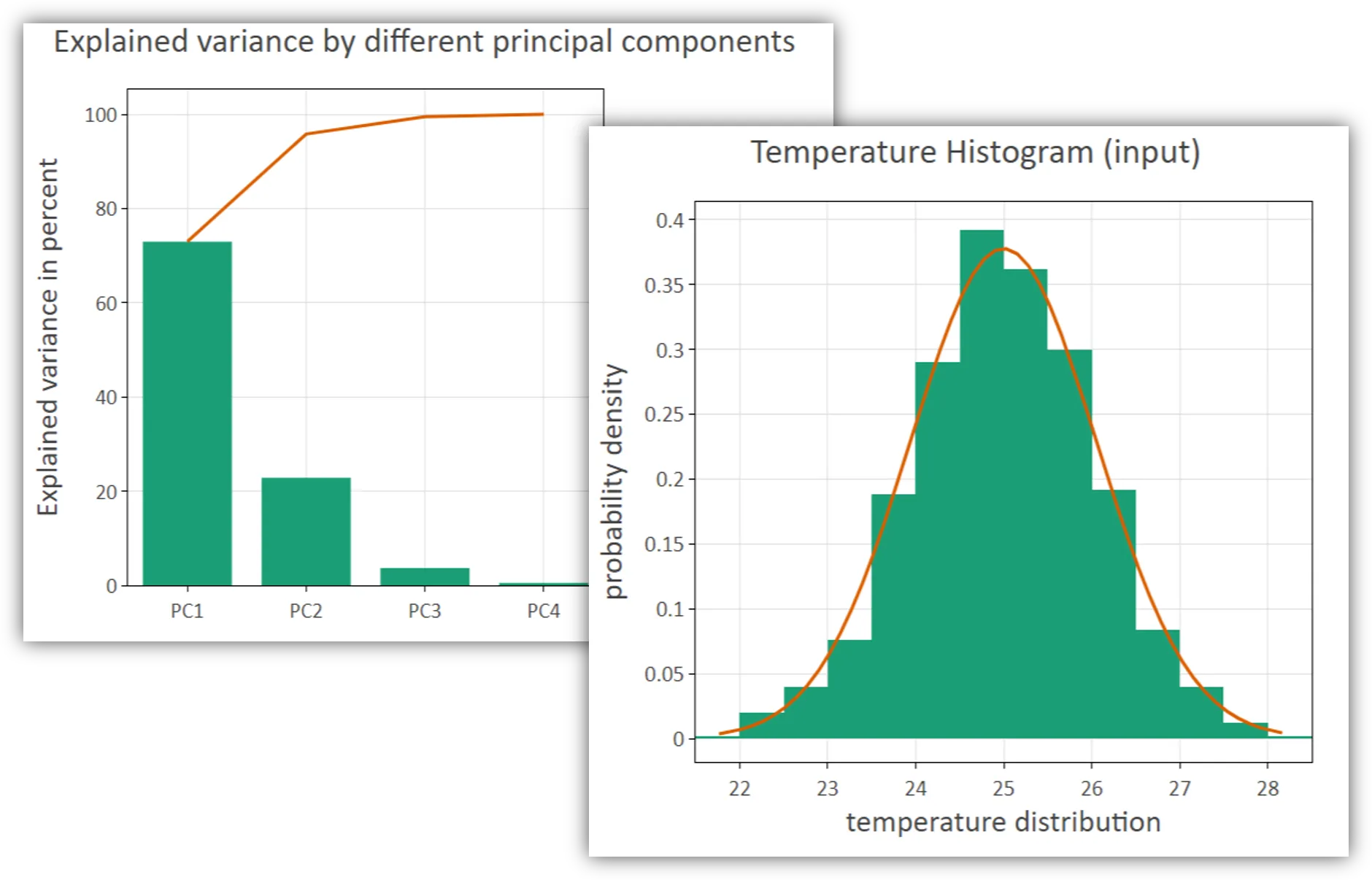
- Compute descriptive statistics and histograms for any variable in your samples or model output.
- Principal component analysis
- Understand and reduce the complexity of large hydrochemical datasets with PCA.
Typical uses
- Uncertainty ranges for saturation indices
- Sensitivity of results to input chemistry
- A published figure a reviewer can reproduce exactly
- Grouping samples by dominant processes
Other modules
01CommunityAkvaIon balance, water types, irrigation indices and the three diagrams02CommunityPhreeqcInputs, databases, selected output and parametric runs03ProPredominancePredominance, Pourbaix and mineral stability diagrams05ProOptimizationFit kinetics, isotherms and titrations to lab data06ProDatabaseLook inside a thermodynamic database, and compare several
Bring your existing PHREEQC models
Inputs and databases import as they are. PHREEQC is bundled, so you can start in minutes.